SBI Clerk Syllabus 2026 for Prelims and Mains-Every year, lakhs of banking aspirants start their SBI Clerk preparation with high hopes, but many lose momentum simply because they don’t know exactly what to study and what to skip. The SBI Clerk Syllabus 2026 lays out a clear roadmap for both the Prelims and Mains stages so that your effort goes into the topics that actually carry weight in the exam. From English Language and Quantitative Aptitude to Reasoning Ability, General/Financial Awareness, Computer Aptitude, and Data Analysis & Interpretation, a solid grip on the syllabus is the first real step toward a smart, targeted preparation strategy.
SBI Clerk Syllabus 2026: Quick Overview
Before diving into the section-wise breakdown, here’s a snapshot of the exam structure that every candidate should know at a glance.
| Organization | State Bank of India (SBI) |
| Post Name | Junior Associate (Customer Support & Sales) |
| Exam Name | SBI Clerk 2026 |
| Exam Mode | Online (Computer-Based Test) |
| Stages of Exam | Prelims, Mains, Language Proficiency Test (LPT) |
| Prelims Duration | 1 hour |
| Mains Duration | 2 hours 40 minutes |
| Prelims Total Questions | 100 |
| Mains Total Questions | 190 |
| Negative Marking | 0.25 mark deducted for each wrong answer |
| Selection Process | Prelims → Mains → LPT |
| Official Website | www.sbi.co.in |
SBI Clerk Prelims Exam Pattern 2026
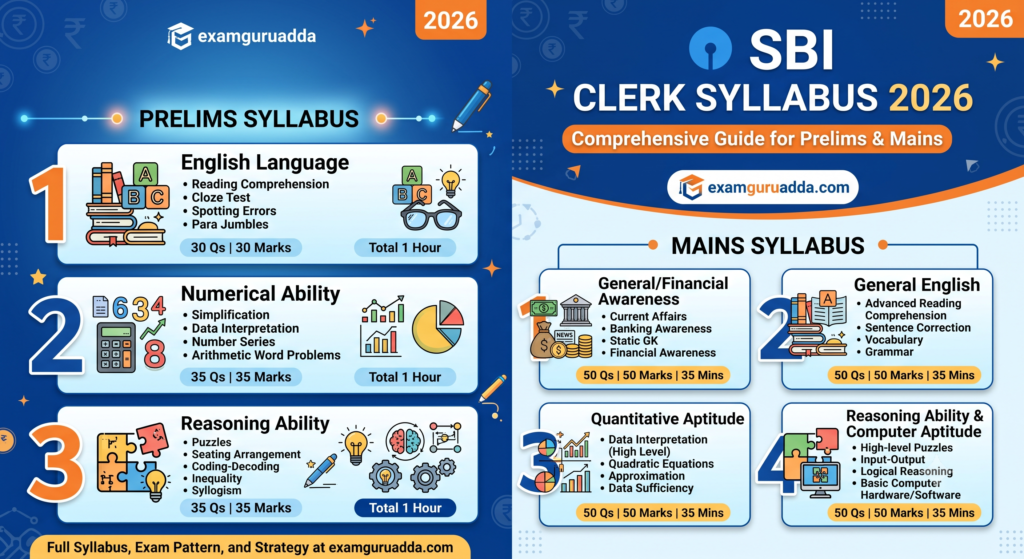
The Prelims stage is a screening test of 100 marks to be completed in just 1 hour, with individual sectional time limits of 20 minutes each.
| S. No. | Name of Test (Objective) | No. of Questions | Max Marks | Duration |
|---|---|---|---|---|
| 1 | English Language | 30 | 30 | 20 minutes |
| 2 | Numerical Ability | 35 | 35 | 20 minutes |
| 3 | Reasoning Ability | 35 | 35 | 20 minutes |
| Total | 100 | 100 | 1 Hour | |
SBI Clerk Mains Exam Pattern 2026
The Mains exam is worth a total of 200 marks and is considerably tougher and more time-intensive, spread across four sections with individual timings.
| S. No. | Name of Test (Objective) | No. of Questions | Max Marks | Duration |
|---|---|---|---|---|
| 1 | Reasoning Ability & Computer Aptitude | 50 | 60 | 45 mins |
| 2 | General English | 40 | 40 | 35 mins |
| 3 | Quantitative Aptitude | 50 | 50 | 45 mins |
| 4 | General/Financial Awareness | 50 | 50 | 35 mins |
| Total | 190 | 200 | 2 Hrs 40 mins | |
Important Notes:
- Trained SBI apprentices may receive 2.5% bonus weightage (5 marks out of 200) in Mains, added to their aggregate score.
- Negative marking of 1/4th mark applies in both Prelims and Mains for every wrong answer.
- Both Prelims and Mains have strict sectional timing — you cannot shift time from one section to another.
- The final merit list is prepared based on Mains marks only; Prelims is qualifying in nature.
SBI Clerk Prelims Syllabus 2026 (Topic-Wise)
Cracking the SBI Clerk Prelims isn’t about studying more — it’s about studying smart. With such a wide-ranging syllabus, a clear strategy is your biggest edge. Prioritize high-scoring topics, stay consistent, and you’ll see steady gains in both speed and accuracy.
Quantitative Aptitude
| Topic | Expected No. of Questions |
|---|---|
| Simplification/Approximation | 10 |
| Data Interpretation (Bar/Line/Pie/Tabular) | 5 |
| Quadratic Equation | 5 |
| Missing/Wrong Series | 5 |
| Arithmetic (Average, Ratio, P&L, Ages, SI/CI, Time & Work, Pipes & Cisterns, Partnership, Mixture, Mensuration, Speed/Distance/Time, Boat & Stream, P&C, Probability) | 10 |
| Total | 35 |
Reasoning Ability
| Topic / Sub-Type | Expected No. of Questions |
|---|---|
| Puzzles (Box/Floor/Comparison/Categorized/Uncertain/Day-Month-Age) | 10 |
| Seating Arrangement (Circular/Triangular/Square/Rectangular/Linear/Double Row) | 5 |
| Coding-Decoding / Alphanumeric Series | 5 |
| Syllogism / Inequality | 5 |
| Blood Relation / Direction & Distance / Order & Ranking | 3 |
| Input-Output / Miscellaneous (Word Formation) | 1 |
| Data Interpretation (part of the section) | 6 |
| Total | 35 |
General English
| Topic | Expected No. of Questions |
|---|---|
| Reading Comprehension / Inference / Sentence Completion | 10 |
| Cloze Test / Phrase Replacement / Fillers | 5 |
| Error Detection / Sentence Improvement / Error Correction | 5 |
| Para Jumbled / Odd Sentence / Word Rearrangement / Column-based | 5 |
| Paragraph Conclusion | 5 |
| Total | 30 |
SBI Clerk Mains Syllabus 2026 (Topic-Wise)
With the Mains exam approaching, candidates should shift focus toward smart revision — prioritizing high-frequency topics and building conceptual clarity rather than rote memorization.
Reasoning Ability & Computer Aptitude
| Topic | Expected No. of Questions |
|---|---|
| Seating Arrangement & Puzzles (All Types) | 18 |
| Machine Input-Output | 5 |
| Logical Reasoning (Assumption, Conclusion) | 6 |
| Coding-Decoding (New Pattern) | 4 |
| Data Sufficiency | 3 |
| Coded Inequality | 4 |
| Direction & Distance | 3 |
| Blood Relation | 3 |
| Syllogism | 2 |
| Alphanumeric Series | 1 |
| Word Formation / Meaningful Word | 1 |
| Total | 50 |
General/Financial Awareness
This section carries no fixed topic-wise question count, but candidates should stay updated across the following areas:
- National & International Current Affairs
- State Current Affairs and Sports News
- Central Govt Schemes, Agreements/MoUs, Summits & Conferences
- Books & Authors, Defense News, Science & Tech News
- Banking & Insurance News, RBI in News, Static Banking
- Ranks/Reports/Indexes, Business & Economy, Union Budget
- Important Days, Obituaries, Appointments, Awards & Honors
- Apps & Portals, Committees/Councils, International Loans, Abbreviations
English Language
| Topic | Avg. Questions/Year |
|---|---|
| Reading Comprehension | 15 |
| New Pattern Cloze Test | 5 |
| Phrase Replacement | 4 |
| Odd Sentence / Para Jumbles | 6 |
| Sentence Completion | 3 |
| Connectors | 3 |
| Column Based | 2 |
| Word Rearrangement | 2 |
| Total | 40 |
Quantitative Aptitude
| Topic | Expected No. of Questions |
|---|---|
| Data Interpretation (Bar, Line, Pie, Tabular, Caselet) | 20 |
| Arithmetic (Profit & Loss, SI/CI, Time & Work, Speed, etc.) | 10 |
| Quantity Comparison (Q1 & Q2) | 5 |
| Data Sufficiency | 5 |
| Approximation | 3 |
| Quadratic Equation | 2 |
| Number Series (Missing/Wrong) | 2 |
| Miscellaneous (Statement-based, Caselet variations) | 3 |
| Total | 50 |
SBI Clerk Language Proficiency Test (LPT)
The LPT is a qualifying-stage test conducted after Prelims and Mains, and before final joining.
- Candidates who studied the local/opted language in Class 10th or 12th are exempt — they simply submit their mark sheet or certificate as proof.
- Candidates who have not studied the local language must appear for the LPT.
- The test is qualifying in nature — marks are not added to the merit list.
- Failing the LPT leads to disqualification, so it cannot be taken lightly.
| S. No. | Test Type | Section | No. of Passages | No. of Questions | Marks |
|---|---|---|---|---|---|
| 1 | Non-Verbal | Objective | 3 | 15 | 15 |
| Subjective | 3 | 15 | 15 | ||
| 2 | Verbal | — | — | 20 | 20 |
Preparation Tips for SBI Clerk 2026
A well-planned strategy combined with consistent practice can significantly improve your chances of clearing both Prelims and Mains.
- Understand the latest exam pattern and syllabus thoroughly before you start preparing.
- Create a daily study timetable with dedicated time for every section.
- Strengthen fundamentals in Quantitative Aptitude, Reasoning, and English first.
- Solve previous year question papers to understand question level and trends.
- Take full-length and sectional mock tests regularly to build speed and accuracy.
- Analyze every mock test carefully to identify and fix weak areas.
- Revise important formulas, grammar rules, and current affairs frequently.
- Practice strictly within the actual exam time limits to sharpen time management.
- Stay current with banking and financial awareness, especially ahead of Mains.
- Maintain consistency — don’t leave any single section completely unattended.
FAQs
What is the syllabus for SBI Clerk?
The SBI Clerk syllabus differs for each stage. Prelims covers Quantitative Aptitude, Reasoning Ability, and English Language. Mains covers General/Financial Awareness, General English, Quantitative Aptitude, Reasoning Ability, and Computer Aptitude.
Is there an interview in SBI Clerk 2026?
No, there is no interview round in the SBI Clerk selection process. Selection is based on Prelims, Mains, and a qualifying Language Proficiency Test (LPT).
Is there negative marking in the SBI Clerk exam?
Yes, 0.25 marks are deducted for every wrong answer in both the Prelims and Mains exams.
Where can I get the complete SBI Clerk Exam Pattern 2026?
The complete section-wise exam pattern for both Prelims and Mains is detailed above, covering number of questions, marks, and duration for each section.
What is the Language Proficiency Test (LPT)?
The LPT is a qualifying test for candidates who haven’t studied the local/opted language up to Class 10th or 12th. It is conducted after Mains and before joining, and candidates must pass it to be finally selected.

